Why the drawer tells you about the whole piece
19 August 2026 · By Ray Denton
A drawer is the one component that gets pulled, loaded and slammed thousands of times. It is where corner-cutting shows up first.
What the joint has to resist
A drawer corner has an awkward job. Every time the drawer is pulled, the front tries to separate from the sides, and the load is pulling straight out along the grain. Fasteners are poor at resisting that. Glue alone on end grain is poor at it too. What works is a joint where the wood itself is shaped so that pulling the front makes the parts lock together rather than come apart.
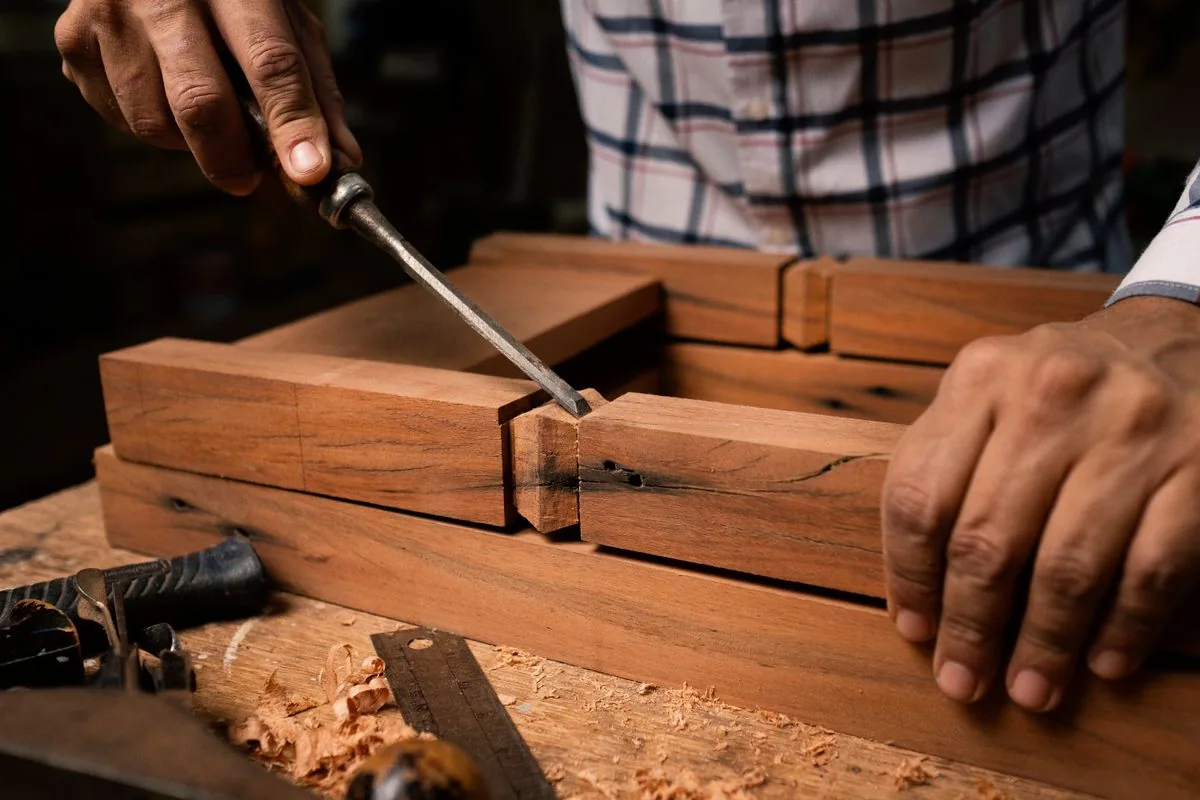
That is precisely what a dovetail joint does. The interlocking wedge-shaped pins and tails mean the joint physically cannot be pulled apart in the direction of use - it has to be slid apart sideways, which the drawer's geometry does not allow. The glue then only has to stop it sliding. It is a very old solution and nothing has improved on it for this particular problem.
The grades you will actually meet
In a showroom you will meet three grades. Hand-cut dovetails are slightly irregular, with pins usually narrower than the tails, and appear on genuinely expensive work. Machine-cut dovetails are perfectly even and identically spaced - the standard mark of decent factory case goods, and entirely sufficient. French or English dovetail describes a drawer where the front is rebated and the sides are joined into it, common and fine.
Below that: dowelled joints, where round pins are glued into drilled holes. Respectable in a well-made piece, and much better than nothing, though they rely on the glue in a way a dovetail does not. Then stapled or nailed butt joints, where the side simply meets the front and is fastened through. This is the one that fails, and it fails predictably - the fastener works loose in the end grain, the corner opens slightly, the drawer starts to rack, and then it stops running properly.
The bottom panel and the runners
Two more details worth thirty seconds. The bottom panel should sit in a groove cut into all four sides, so the drawer's own structure holds it; if it is stapled flat onto the bottom edges, it is carrying its load on the staples and will eventually sag or drop. And the runners: wooden runners riding in a wooden groove are quiet and last indefinitely but need occasional wax; metal ball-bearing slides are smoother and take more weight; plastic-on-plastic is the one to be wary of on a drawer that will hold anything heavy.
Why the drawer predicts the rest of the piece
The reason all this deserves attention out of proportion to its size is that drawer construction is an excellent proxy. A factory that cuts dovetails has the machinery, the timber and the process time to do it, and that shows up everywhere else in the piece. Nobody builds a carefully dovetailed drawer into an otherwise careless carcass.